
Showing posts with label Energy Efficiency. Show all posts

Tuesday, April 6, 2010

The New Building in Town – Workplaces of the Future

Make way, Colorado; a ground-breaking workspace will call our state home this June.

As you may know, the U.S. Department of Energy (DOE) is building a sustainable office space in Golden, Colorado that will support some 800 staff from both its National Renewable Energy Laboratory (NREL) and the DOE’s Golden Field Office. The building, which will be located on NREL’s campus, will feature roughly 220,000 square feet of space that meets LEED Platinum certification requirements. The project, for which the Department of Energy awarded $64 million in contract funds, will be “a showcase for energy efficiency and renewable energy technologies” (Source: www.nrel.gov).  (Image Credit:  http://online.wsj.com)

A Net-Zero Footprint - Smart Spaces on a Budget

The primary goal of this office is net-zero energy use and the hope is that what they learn in the planning and building processes transfers toward the DOE’s previously stated goal of commercially viable net-zero energy buildings by 2025 (Source: www.eco-structure.com, September 19, 2009). In order to serve as a model project for the commercial construction industry, a key goal is to keep the building’s construction within reasonable cost levels – it comes out to about $280 per sq/ft unfurnished – and to widely publish the project’s results (Source: http://online.wsj.com).  (Photo Credit: www.nrel.gov)  

The building is slated to open in June of this year and is called the Research Support Facilities (RSF) center. Everything from the workspace layouts to the general structure was shaped and oriented to maximize natural light exposure.  The building itself resembles an "H" shape and is engineered so that no area inside is more than 30 feet from a window and natural light sources. High-level staff members, for example, will work in offices that have walls only six feet tall and cubicles will be in an open-air configuration with very little in the way of walls in between them. Click here to read more detail on the workspace engineering concepts included in the RSF. (Image Credit: www.nrel.gov)

Windows That Do More 

A system of smart windows plays a large role in the efficient use of the variety of lightning conditions that the building will experience, including:

  • Heat-loss control
  • Angled interior reflection to maximize interior lighting
  • Sunshades to prevent work station glare
The windows will also open to vent excess heat in the warm months at night and will use the cooler night air to naturally bring down the temperature of the building. They were built with a special self-darkening film - which could cut down on energy waste via windows by up to 40% - that responds to the outside temperature.  To find out how the windows work, please click here and select the "Raven Window" option.   (Photo Credit: www.nrel.gov)

A Different Kind of Basement
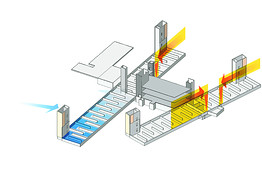
Another unique feature of the building is an innovative basement-level series of concrete walls that will either capture and slowly transmit heat - from the computer center and a transpired air collector - or capture and transmit cooler air (from nighttime collections), depending on the seasons.

Pulling the outside air through this concrete labyrinth can warm it up by 5 - 10 degrees. The key to heating the building in the winter is the transpired air collector design, which minimizes loss and allows ventilated air to be heated as it enters the building. To read more about how these transpired air collectors work, please click here.

Turning on the Lights - On-Site Renewable Generation

Desk-based lighting is automatically controlled by the building to illuminate when a certain level of darkness is reached. In addition, there’s no “set temperature” for the building – it will be allowed to fluctuate between 68 and 80 degrees before energy-powered heating or cooling sources kick in. Even the cubicles themselves were built to use less energy than the current standard of 10.8 kilowatt-hours of electricity a month (instead using 2.8), and the workstations save additional energy by using laptop computers instead of desktops (Source and Image Credit: http://online.wsj.com/).

For the inevitable amount of energy that the building will require to operate, the DOE is building a Photovoltaic system that can generate up to 1.4 megawatts of energy specifically for the RSF.  Given that Colorado has the fifth greatest solar potential in the United States, these panels should be capable of covering most of the building's leftover energy needs (Source:  www.energyboom.com, April 6). To see how the construction and architecture group got around the hurdles associated with the recycled piping, please click here

Even the Building Blocks Are Green
When the DOE and NREL originally started the planning process on the Research Support Facility, they tried to keep the footprint of the building process itself as green as possible. The building structure consists of recycled steel pipe from old natural gas lines and the building uses beetle-kill wood panels and interior throughout. For information on how the construction team worked

Final Note

Don't be fooled by all of the functional design of the RSF - efficient does not mean bare.  This building achieves all of the above and still comes complete with such luxuries as a fitness center and a library for employees (Source: 
www.nrel.gov).  To learn more about this amazing, ground-breaking building, please click here.

Sunday, February 7, 2010

Great News - The State Energy Efficiency (SEE) Action Network

The Environmental Protection Agency and the U.S. Department of Energy recently announced the creation of the State Energy Efficiency Action Network (SEE Action Network), a body that will help states implement and oversee energy efficiency programs (Source:  Energy.gov, February 2).  This move, which provides support and expertise from the federal side of things, could not come at a better time.  State budgets are in the red nationwide, resulting in personnel and program cuts, while federal funding for energy efficiency programs is at an all-time high.  The net effect of these two factors is that many states are having a difficult time accessing, implementing, and tracking energy efficiency projects at a time when the funding is available to make significant strides in energy savings across the nation. (Photo Credit: http://www.wordpress.com/

I wrote about one example of this in my January entry, where I discussed the challenges of implementing large-scale weatherization programs in our current economic climate.  I cited some issues discovered in Illinois through a random DOE audit of these newer programs in which a contractor did some weatherization work on behalf of the state that was later deemed unsafe.   This move by the EPA and DOE ensures that all of us, homeowners, businesses, workers and manufacturers of energy efficiency materials will benefit and that those dollars will be spent wisely.  (Photo Credit: http://www.smartpower.org/)

The SEE Action Network will follow a set of guidelines set forth in the National Action Plan for Energy Efficiency, a public-private partnership that launched in 2005 to create an hard-hitting plan for energy efficiency supported by utilities, regulators, and other private businesses.  The action plan’s goal is ambitious; “to achieve all cost-effective energy efficiency by the year 2025,” but this program is now pledging to meet this goal five years sooner than originally planned (in 2020).   I am excited to see what comes of the SEE Action Network and will surely track its progress along the way. (Photo Credit:  http://www.ncsl.org/

Friday, January 8, 2010

Energy Efficiency Programs - News, Notes and New Year's Resolutions

One interesting energy efficiency initiative in the early days of 2010 comes from the technology sector, specifically in IT and communications. Companies ranging from IBM to Yahoo! will receive portions of a $47 million grant from the U.S. Department of Energy to improve energy efficiency within their offices and operational centers, the DOE announced on January 7, 2010. The funds, which are part of the American Recovery and Reinvestment Act, will be paired with approximately $70 million more in private-sector funds to reduce the 3% overall (120 billion kWh per year) demand that the companies’ operational centers drain annually from the nation’s energy grid (Source: RenewableEnergyNews.com, January 7).  These companies are so innovative when it comes to their technological and communications solutions that it should be very interesting to see what measures they come up with to improve their energy efficiency. The DOE's investment here could spark unique efficiency innovations that apply to commercial building efficiency projects nationwide.  (Photo Credit: http://www.cleantechnica.com/)


The Challenges of Large-Scale Weatherization Implementation

While city, county and state governments are beginning to feel the influx of money allocated toward weatherization programs, a recent red flag in Illinois illustrates the difficulty in managing these large-scale stimulus-funded weatherization efforts. When the U.S. DOE recently examined $242 million in weatherization funding allocated to the state of Illinois, it found that one of state’s contractors, which was overseeing and implementing the projects, did not thoroughly inspect or safeguard its work. The audit found that one contractor failed to detect a potentially dangerous gas leak and that the state, which is required to inspect 5% of the homes that are weatherized under its program (by the contractors), did not conduct all of the necessary inspections (Source: NewYorkTimes.com, December 21, 2009). (Photo Credit: http://www.homeenergy.org/)

This finding sheds some light on the set of challenges facing these wonderful programs. It is critical to expediently funnel this unprecedented funding into the maximum number of beneficial weatherization projects possible and to ensure that they’re all safely executed. Yet staffing on a state, county, city or contractor level may not have caught up with the program’s requirements, particularly because government budgets at all levels are so stretched. One definitively positive outcome from this finding will be that all participants will tighten up procedures and oversight, in some cases by adding adequate staffing, thus ensuring the appropriate use of taxpayer money for the lofty and worthy goals set forth by the program. Expect to see changes on this front in the coming months.

Energy Efficient Appliance Rebates - State vs. Federal Oversight

The effect of a $300 million U.S. government rebate program aimed at the purchase of energy efficient appliances meeting federal Energy Star designations may be tripped up by state oversight, say industry experts. The structure of the rebate program dictates that the rebate terms and timing will be handled individually by the states, rather than the federal government. Some industry experts contend that the inherent inconsistencies in the states’ handling of these funds will hinder a much-needed boost to the appliance industry (Source: Online.WSJ.com, January 8). The counter-argument to these comments, however, is that each state has unique needs when it comes to its population and that programs which may be popular and useful in one state may be stagnant and largely inapplicable in another. Time will tell how popular these programs turn out to be and how large of an impact they will have on the appliance manufacturers, but chances are good that these manufacturers will see a significant boost in business once these programs are in full swing no matter how they are administered. (Photo Credit: www.mytorontohomeimprovement.com)


Major City’s Commitment to Energy Efficiency Grows

In some energy efficiency news across the Atlantic, it appears that new commercial building developments in London are cutting carbon emissions by one-thid as a part of Mayor Boris Johnson’s push to cut the city’s total emissions by 60% in 2025. According to reports, 71% of London’s emissions come from buildings, so these efforts are crucial to keeping on track with Mayor Johnson’s goal (Source: RenewableEnergyNews.com, January 7). In addition, the Mayor’s Building Energy Efficiency Programme (BEEP), which aims to deliver energy efficiency retrofits on an expedient basis, continues to see new signatories, recently welcoming energy supplier EDF Energy. Mayor Johnson has also pledged to tighten carbon emissions standards for all buildings sometime in the next four years, which has spurred preemptive action on the part of several private-sector companies.  (Photo Credit:  http://www.tripadvisor.com/)

In other developments beyond our borders, the U.S. Department of Energy announced three projects under the Low-Carbon Communities of the Americas (LCCA) program, which was announced in June 2009 and aims to assist Latin American countries with the implementation of energy efficiency measures (Source: http://www.doe.gov/, January 8). Included within the three projects are training programs, wind generation program testing, and technical support programs for everything from auditing to reporting in Costa Rica, several Caribbean nations, and Dominica.

Tuesday, August 18, 2009

Changes in the Residential Energy Efficiency and Renewable Energy Marketplace

Off the Grid - Total Energy Solutions for the Home

In an effort to serve growing demand for a broad spectrum of energy efficiency improvements that can be made to our homes, GE recently announced plans to become a one-stop shop for residential energy efficiency products (Source: EnergyEfficiencyNews.com, July 15). In addition to some of the more conventional products that GE offers, such as energy efficient light bulbs, appliances, and climate control consoles, the company will soon add residential energy generation and storage products. GE estimates that by improving the energy use of appliances, HVAC systems, and lighting, peak energy demand will decline by 7% in the United States.

As we look at the expansion of energy offerings that could feasibly enter the residential market in the coming months and years, one wonders which methods will truly be the most cost effective in the long run. Though most people are aware by now that better insulation, smart climate control consoles, energy efficient light bulbs and other small items can drastically reduce energy waste in their homes, what can be said of energy generation products designed for residential use?

For most, residential solar panels, wind turbines and other energy generation technologies have historically been out of reach both financially and logistically. As I mentioned in this earlier blog, however, the options available to the average homeowner in terms of renewable energy hardware and financing for such systems are increasing rapidly. The price of solar panels, for example, has dropped 40% this past year, opening the door for some to consider installation of such panels on their property for the first time (Source, NewYorkTimes.com, August 28).

In addition to improvements in technology and the reduction in price of some renewable energy components, government and utility subsidy programs for residential renewable energy systems are also starting to gain momentum. Though a reduction in market pricing and increases in availability of private financing for such systems is a positive trend, the impact of government subsidization and financing programs face a high standard of scrutiny. With a wider range of options now available for both energy conservation and renewable energy generation in the typical residence, a recent article in the Wall Street Journal raises an important question where our tax dollars are concerned; “…should the government be doing more to subsidize conservation?”

This same article cites a study by a consulting firm McKinsey & Co. that examined the cost of eliminating one ton of CO2 emissions via different methods, including light-emitting diodes, energy efficient appliances, wind power and solar power (Source, Online.WSJ.com, July 15). The study found, not surprisingly, that reducing energy demand through an upgrade of more efficient items for the home reduced CO2 more cheaply than generating new energy through the installation of renewable energy collection devices. The latter part of this article goes on to discuss a bill that’s pending in congress right now that would do just such a thing by offering tax incentives for homeowners and businesses who install these energy saving items. In addition to its focus on reducing energy demand, the bill is structured on a results-basis so as to provide the greatest incentive for the most energy demand reduced.

Government Funding - Upgrades for the Home

Many countries worldwide are rolling out with similar energy efficiency incentive packages, such as a £15 million home makeover package, which will provide free energy audits, advice, and free or discounted insulation materials to 96,000 homes (Source: EnergyEfficiencyNews.com, August 3). As I mentioned in an earlier blog, there are similar programs being considered or implemented at national, state and local levels, such as Boulder County's (Colorado) ClimateSmart program, which loans income-qualified homeowners up to $50,000 to make energy efficiency improvements to their homes and applies the debt to the property itself. ClimateSmart participants may also install renewable energy hardware under the program, including photovoltaic, solar thermal, or wind energy systems (a full list of approved projects is available at this link).


On a national level and as a part of the American Recovery and Reinvestment Act, tax credits are available at 30% of the cost, up to $1,500, in 2009 & 2010 for several energy efficiency improvements to existing homes, including roofs, HVAC upgrades, insulation, water heaters and more (Source: EnergyStar.gov). On the renewable energy side, the Federal Government is offering a 30% individual tax credit for residential solar electric expenditures through December 31, 2016, several of which have no upper limit on the base cost (Source: Energy.gov, EnergyStar.gov). This renewable energy tax credit includes small wind property credits with a cap of $4,000 and geothermal heat pumps up to $2,000.

Return on Investment - Thoughts on Spending Stimulus Dollars Wisely

As efforts to reduce CO2 emissions ramp up in the United States and worldwide, it will be interesting to see how many new programs will be geared toward simple efficiency upgrades as opposed to renewable energy research and industry. Currently, there's a wide variety of funding and programs in place at the federal, state, county and some city levels for either or both types of improvements. While the goal is to ultimately reduce our overall pollutant waste, we should also be mindful of squeezing the most energy savings out of each dollar we spend wherever possible. I expect to see a rash of cost-effective net energy-savings studies on both commercial and residential properties in the coming months as individuals and builders begin utilizing stimulus funding to pursue these upgrades. My hope is that these studies will also factor in the net employment stimulus effect that these projects are having so that funding is most strongly allocated to those that are serving the dual purpose of employing the most workers for the most energy savings gained per dollar spent.

Monday, June 29, 2009

Programs That Work: Energy Efficiency Initiatives with Power in a Recession

There's a lot of buzz out there around the idea of reducing energy waste in new construction projects. Hundreds of researchers, architects and construction companies have perfected dozens of highly effective building methods, materials and mechanisms to create efficient new buildings in both the commercial and residential markets.

While promoting the latest and most cost-effective methods in new construction projects is a step in the right direction, less clarity and more challenges exist on the topic(s) of how to promote energy efficiency upgrades in existing homes and office buildings. "Nearly half of America’s energy - and 10 percent of the energy used in the world - goes towards powering our buildings, and much of that energy is wasted. Buildings account for 40 percent of total U.S. carbon dioxide emissions, a major contributor to global warming. " (Source: EnvironmentMinnesota.org, 6/2/09).

In addition to all of the hurdles associated with retrofitting existing structures including the cost of materials and the wide variance in structural design, building owners face the additional pressures of a prolonged recession. How then can we encourage residents, businesses, construction contractors and local governments to take on the additional short-term costs of adding energy efficient components to the property they own?

While I do not pretend that I have a solid answer to this question, I would like to examine programs and incentives with a great deal of potential in these times of economic stress. Virtually all of these incentives are government based and many of them are tied to the economic stimulus legislation that originated in Washington, D.C.

One such initiative that caught my eye recently is Boulder County's (Colorado) ClimateSmart program. The 6.6 million dollar program, approved by county voters last November, allows for homeowners to apply for a loan of up to 20% with a limit of $50,000 to make energy efficiency improvements to their homes. The unique part about this program is that it ties any loans granted are attached to the property, rather than the owner. The owner pays a special assessment in property taxes, but will not carry the loan with them should they sell the property (Source: The Denver Post, 6/27/09).

In a time where homeowners are struggling with their mortgages, worrying about the safety of their jobs and doing whatever they can to make ends meet, this program may be particularly attractive. For any homeowner who wishes to make such improvements but does not wish to take additional risks with their own credit in case of emergency (through tapping into their home equity line of credit or by taking out standard loans from a bank), this is an incredible opportunity. In addition, the long-term cost-comparison between the standard credit options and this county incentive program stacks favorably for the county's option.

A second, and more traditional, incentive program is the Renewable Energy Finance Act of Colorado, which was signed on April 22nd of this year. This is also a government reimbursement program (on the state level) that's focused primarily on the financing of solar electric systems and the cooperation of local utilities on streamlining access to solar rebate programs to customers of all income levels (Source: Colorado.gov, 4/22/09). "SB51 doesn’t create a pot of money for homeowners or businesses to directly borrow. Instead, the act creates a fund in the Governor’s Energy Office, which provides the backing to banks and other lenders to make clean energy loans." (Source: Todd Hartman, spokesman for the Governor’s Energy Office, The Summit Daily News, 4/23/09). In the same article, author Tillie Fong mentions that the upfront cost of the average residential solar panel system is between $6,000 and $8,000, a significant barrier when loan money systems are in a tight recessionary period as they are today. With this program, the party who installs the equipment will own the equipment until the resident pays it off. In addition, the loan is secured by the Governor's Energy Office, rather than the customer.

Again, this government incentive model shifts the lending burden off of the homeowner and allows them to pursue the improvements so long as they can make the monthly payments (which are likely to be at a lower interest rate than with a privately secured loan).

Another type of energy efficiency program comes from electric cooperatives and providers in a given area. One such example is a program promoted by the Colorado Springs Utility, which provides low interest rate financing for some pre-approved energy and water efficiency home improvement projects. The loans range from $1,000 to $50,000 and are separate from their Renewable Energy Rebate Program, which gives customers a credit on their bills for setting up solar panels and connecting them to the utility's electric grid, a common credit offered by a wide variety of electric utility providers (Source: SolarPowerAuthority.com).

This program follows the same type of model that the Renewable Energy Finance Act does by using the borrowing power and backing of the utility to negotiate loans for in the individual customers, much as a health insurance pool will do. Without the backing of the utility, many of their customers would be unable to finance such improvements in the first place or may not be able to afford the higher loan rate(s) available as individuals.

There are literally thousands of programs out there that try to foster energy efficiency upgrades among residential and commercial developments, but the three above illustrate important options and models that may be more effective than others. The Boulder County ClimateSmart program is, in my opinion, the most compelling of the three at this fragile moment in our economy for the simple fact that the owner of the property is not stuck with the burden of the loan in the long run. Though I believe that we have a long way to go in promoting these improvements in our existing buildings and thus minimizing energy waste, ideas like these give us more opportunity to make the right - and sustainable - improvements despite the instability of our economic circumstances.